
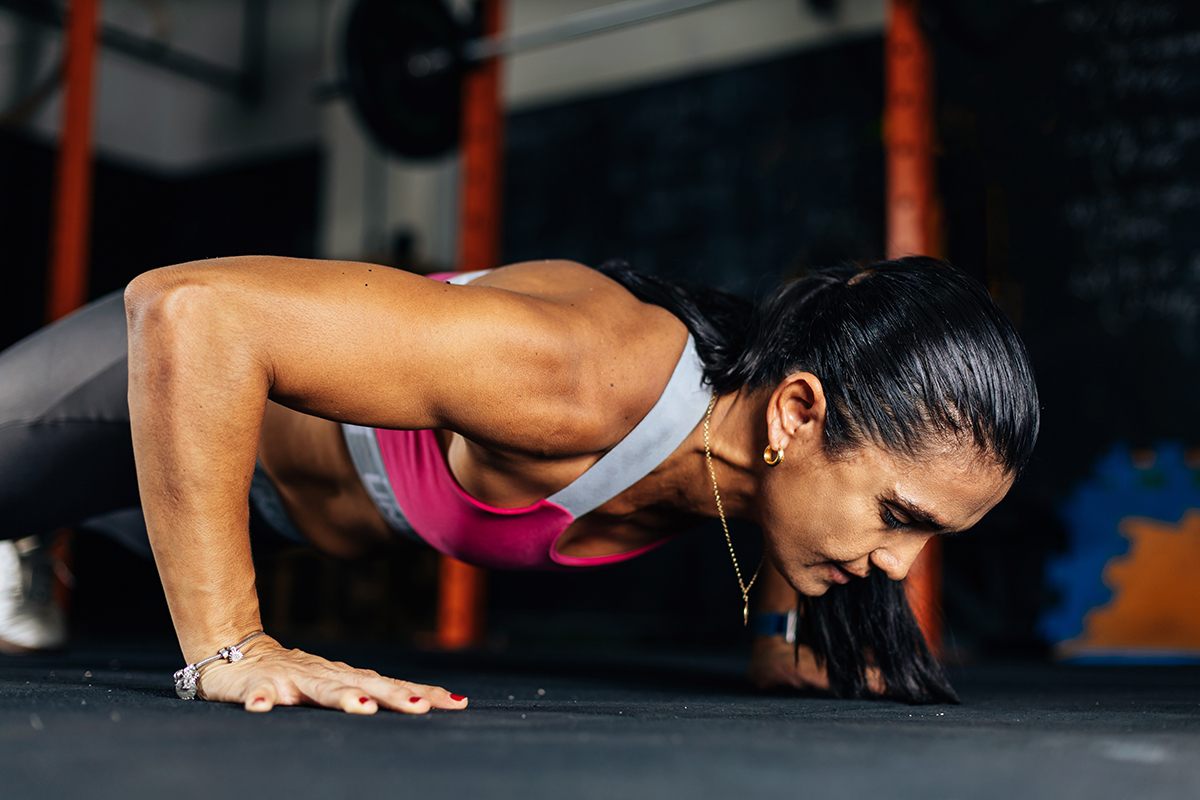
If you’re in your late 30s, 40s, or 50s, you may have noticed that your relationship with exercise is changing.
Maybe the workouts you did in your 20s don’t feel quite as good anymore. Maybe you’re less interested in burning as many calories as possible and more interested in feeling strong, keeping your joints happy, moving well, and having enough energy left for the rest of your busy life.
Or maybe you haven’t worked out consistently in years and are wondering whether it’s too late to start strength training.
Here’s the good news:
It is absolutely not too late to get stronger.
In fact, strength training becomes increasingly valuable as we get older. Resistance exercise can help maintain and build muscle and support the strength, mobility, and physical function we rely on for everyday life. National health guidelines recommend muscle-strengthening activity for adults at least two days each week.
But getting stronger after 40 doesn’t require punishing workouts, chasing personal records every week, or trying to train exactly like you did at 25.
It requires something much more useful:
Training with purpose.
Why Strength Training Matters After 40
Strength isn’t just about how much weight you can lift.
It’s what helps you carry your luggage through an airport.
Get up from the floor.
Pick up something heavy without panicking about your back.
Climb stairs.
Carry groceries.
Garden.
Golf.
Play pickleball.
Keep up with your kids.
Keep up with your grandkids someday.
And continue saying yes when life gives you something fun to do.
Muscle mass and strength naturally begin changing as we move through adulthood. Research from the National Institute on Aging notes that muscle strength and performance begin gradually declining after early adulthood and that staying active—particularly through resistance training—can help slow those changes and maintain mobility and independence later in life.
For women, the years surrounding menopause can bring additional changes in muscle and bone health, making resistance exercise an especially worthwhile part of a long-term fitness plan. Research in postmenopausal women has found that resistance training can improve strength and functional capacity, although individual results and needs vary.
That’s why I think about strength training differently.
We aren’t just training for today’s workout. We’re training for the life you want to keep living.
You Don’t Need to Train Like You Did in Your 20s
There can be a strange moment when you return to fitness after some time away.
Your brain remembers what you used to do.
Your body would prefer a meeting to discuss it first.
That’s okay.
One of the biggest mistakes you can make when returning to strength training is trying to immediately pick up where you left off—or assuming that a workout only “counts” if it leaves you exhausted.
It does not.
A smart strength-training program starts with where your body is now.
Maybe that means lighter weights while you learn or relearn a movement.
Maybe we adjust the range of motion.
Maybe we work on ankle mobility before your squat feels comfortable.
Maybe we strengthen your hips and core so another movement becomes more stable.
Maybe you can handle more than you expected.
The point is that we find out.
Coach Taylor’s Take
I care much more about how well you move than how impressive the weight looks.
Good technique gives us something to build on.
Once you can perform a movement well and with control, we can gradually increase the challenge. That might mean adding weight, repetitions, range of motion, complexity, or another form of progression.
You still work hard.
We’re simply making sure the work is helping you move forward.
5 Things That Matter When Strength Training After 40
1. Technique Comes Before Intensity
More weight is not automatically better.
A well-executed squat with an appropriate load is far more useful than a heavier squat performed with mechanics your body isn’t ready to control.
That doesn’t mean we’re afraid of challenging weights.
Quite the opposite.
I want you to get stronger.
But strength is built through progression, not proving something on Day One.
Learning good technique can also make strength training feel much less intimidating because you begin to understand what you’re doing, what you should feel, and why an exercise is in your program.
That confidence matters.
2. Your Program Should Progress
Doing the exact same workout with the exact same weights forever probably isn’t going to keep making you stronger.
Your body adapts.
As movements become easier, we gradually increase the demand. In strength training, this idea is often called progressive overload.
That progression can look different from person to person.
You might:
- Add a little more weight
- Perform another repetition
- Add a set
- Improve your control
- Increase your range of motion
- Progress to a more challenging exercise variation
The goal isn’t to make every workout harder simply for the sake of being hard.
The goal is to give your body an appropriate reason to adapt.
3. Strength Is Only Part of the Story
I love strength.
But I don’t want you to simply be strong.
I want you to be capable.
That means your training may also include mobility, balance, stability, coordination, and movement control.
These qualities work together.
You need strength to lift a heavy suitcase—but you also need shoulder mobility and control to place it in an overhead bin.
You need strong legs to climb stairs—but balance and stability matter, too.
You may have plenty of flexibility but struggle to control a joint through that range of motion.
That’s why a well-designed program looks at the whole person instead of isolating “strength” from everything else your body needs to do.
4. Recovery Is Part of Training
Your muscles don’t get stronger simply because you worked hard for an hour.
Training creates a challenge. Your body then needs time to recover and adapt.
This is one reason more isn’t always better.
Sleep, nutrition, stress, your training history, the intensity of your workouts, and the other demands on your body all affect recovery.
And if you’re a professional woman balancing a career, family, travel, aging parents, relationships, and the approximately 4,000 tiny things that somehow become your responsibility every week, that matters.
Your training plan needs to fit into your actual life.
Consistency with two or three purposeful sessions each week can be far more valuable than going all-in for three weeks and disappearing for three months.
5. Train for What You Want to Keep Doing
This may be my favorite one.
Ask yourself:
What do I want my body to still be able to do ten years from now?
Travel?
Hike?
Play a sport?
Lift heavy things?
Get on and off the floor easily?
Walk through a city all day on vacation?
Care for your home?
Play with your family?
Live independently?
Your answers tell us something important about how you should train today.
Strength training doesn’t need to be about chasing someone else’s body.
It can be about protecting and expanding what your body allows you to experience.
That’s a completely different relationship with fitness.
How Often Should Women Over 40 Strength Train?
For most healthy adults, national physical activity guidelines recommend working the major muscle groups through strengthening activities on at least two days each week.
Does that mean everyone should follow exactly the same two-day workout?
No.
Some women thrive with two full-body sessions.
Others may benefit from three or more sessions depending on their goals, experience, schedule, recovery, and other physical activity.
If you’re just beginning—or beginning again—two well-planned workouts per week can be a very reasonable place to start.
Then we build from there.
Remember:
The best training schedule isn’t the one that looks most impressive on paper. It’s the one you can recover from, progress with, and consistently maintain.
What Should a Good Strength-Training Program Include?
There is no single perfect workout for every woman over 40.
Your program should reflect your goals, movement abilities, experience, and any individual considerations.
But a well-rounded program will commonly train fundamental movement patterns such as:
- Squatting
- Hinging at the hips
- Pushing
- Pulling
- Carrying
- Bracing and controlling the core
- Moving and stabilizing on one leg
Depending on the person, we may also spend time specifically developing mobility, coordination, balance, or other skills that support those movements.
You don’t need a complicated collection of trendy exercises.
You need the right exercises, performed well, progressed thoughtfully, and practiced consistently.
“But I’m a Beginner. Should I Get in Shape First?”
No.
You do not need to get fit before you start getting fit.
And you certainly don’t have to know your way around a gym before working with a personal trainer.
That’s part of what coaching is for.
If the idea of strength training feels intimidating, you’re not alone. Some women worry that they’ll look silly, perform an exercise incorrectly, or be judged because they aren’t already strong.
I want you to know this:
You are allowed to be new at something.
A good training environment should give you room to learn.
We start with what you can do today. I teach you the movements. We make adjustments. You ask questions. You practice.
Then one day, the thing that once made you nervous becomes the thing you do without thinking twice.
That is progress, too.
Can You Really Build Strength After 40?
Yes.
Aging changes our bodies, but it does not eliminate our ability to respond to strength training. Research supported by the National Institute on Aging shows that older adults can improve strength through resistance exercise, helping preserve physical function and mobility.
The goal isn’t to pretend aging isn’t happening.
It’s to recognize how much influence we still have over the way we move through it.
You can start at 38…45..52..
You can start after a long break.
You can start without being “a gym person.”
The important thing is that you begin with a program appropriate for you and build from there.
Strength for Now. Strength for Later.
For me, strength training is ultimately about possibility.
Yes, I want you to get stronger.
But I also want strength to give you something back.
More confidence.
More capability.
Greater trust in your body.
More freedom to do the things that matter to you.
Because your workout should prepare you for more than your next workout.
It should prepare you for your life.
Ready to Get Stronger?
Coach Taylor provides private, one-on-one personal training for women in San Diego, with an emphasis on proper technique, progressive strength training, mobility, stability, and building confidence in the way you move.
Whether you’re returning to exercise, ready to train smarter, or thinking about what you want your body to be capable of years from now, we’ll start exactly where you are.
Get stronger. Move better. Keep doing what you love.
Schedule your complimentary consultation with Coach Taylor. Call or text (619) 869-1205